
A film’s journey does not always end at the box office. Sometimes, a film fails to attract audiences during its original theatrical run, only to find its true audience years later through television, OTT platforms and, eventually, a return to cinemas. These films remind us that commercial performance at the time of release and long-term cultural impact are two very different measures of success.
To understand this phenomenon, we must first understand how Indian cinema was consumed before multiplexes became widespread.
During the 1990s and early 2000s, single-screen theatres dominated much of India’s theatrical exhibition landscape. Unlike today, audiences had fewer cinema-going options in many cities and smaller towns. A film’s commercial performance depended heavily on its distribution, the number of screens available, its marketing, competition from other releases and how long exhibitors continued screening it. Box-office reporting was also less comprehensive than it is today, making historical comparisons difficult.
In that environment, a film could struggle to reach its intended audience without necessarily lacking quality, originality or entertainment value. A limited theatrical run could restrict its commercial prospects, while a film that opened strongly could benefit from greater visibility and more opportunities to attract viewers. The box office recorded what happened during a particular release window, but it could not measure how audiences might respond to the same film several years later.
That is where television began to change the story.
As satellite television expanded across India, films began reaching households that might never have watched them in theatres. This was particularly important for audiences in smaller towns, rural areas and places where access to cinemas was limited. A film that had completed its theatrical run could now find millions of potential viewers through television broadcasts.
Unlike a theatrical release, which offered a limited window to attract audiences, television allowed films to return repeatedly. Families could watch together, viewers could discover films accidentally while changing channels, and memorable scenes could become part of everyday conversations. Repetition created familiarity, familiarity encouraged affection, and affection eventually turned some films into cult classics.
Andaz Apna Apna (1994) is one of the clearest examples. Its original theatrical performance did not reflect the enormous affection it would eventually receive. Through repeated television screenings, its unusual characters, absurd situations and memorable dialogues became part of popular culture. The film was no longer merely a comedy that audiences had missed; it became a comedy that audiences wanted to revisit.
The same transformation can be seen in Jaane Bhi Do Yaaro (1983), which developed a lasting reputation for its dark satire and extraordinary comic sequences. Agneepath (1990), despite underperforming commercially during its original release, later became celebrated for Amitabh Bachchan’s intense performance and its distinctive cinematic world. Mera Naam Joker (1970), initially a major commercial disappointment, also received greater appreciation over time for its ambition and emotional complexity.
Other films benefited from this changing relationship between cinema and television. Dhol (2007), Deewane Huye Paagal (2005) and Khosla Ka Ghosla (2006) gained enduring audiences through their comedy, performances and relatable situations. Rehnaa Hai Terre Dil Mein (2001) developed a particularly strong following among younger viewers, helped by its music, romantic appeal and repeated television exposure. Its later theatrical re-release demonstrated that a film’s audience can continue growing long after its first appearance in cinemas.
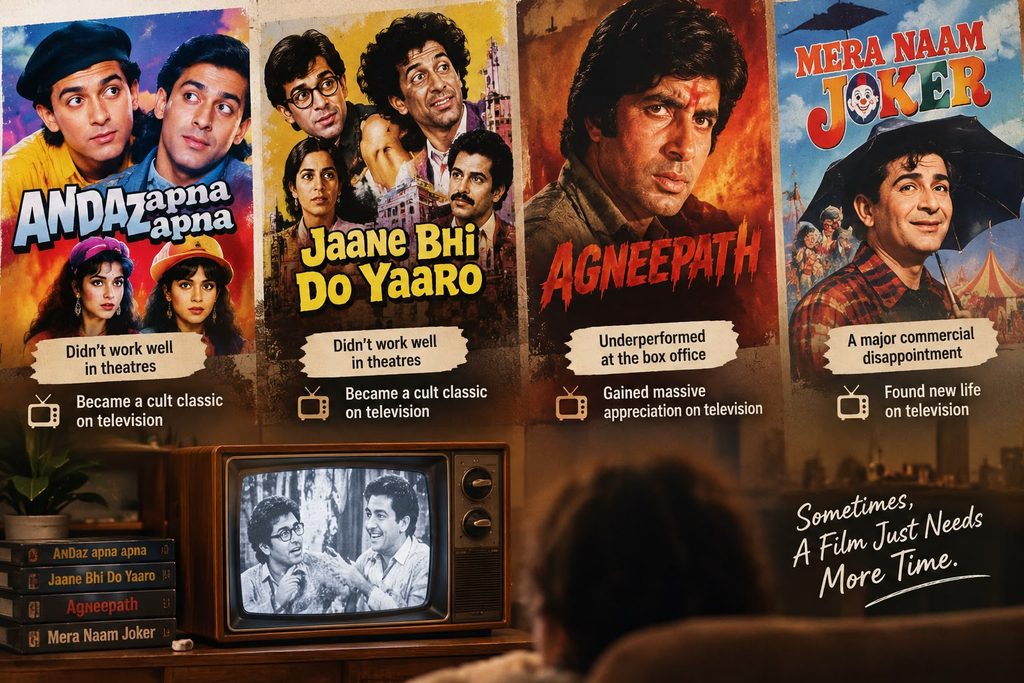
The television phenomenon also reveals why a film’s success should not be judged only by its initial box-office figures. A movie may not have reached enough viewers during its theatrical run, but television can introduce it to a much larger audience over several years. That does not automatically make every such film a masterpiece, nor does it mean that television alone created its popularity. Rather, television provided the opportunity for viewers to discover, evaluate and revisit films that had previously received limited attention.
The digital revolution has taken this process into a new phase.

OTT platforms have changed how films are discovered, discussed and consumed. Viewers no longer depend on a scheduled television broadcast. They can search for a particular title, watch it at their convenience, revisit scenes and recommend it through social media. A film can now find an audience through streaming, online discussion, short clips, video essays and recommendations from younger viewers who may not have been born when it was originally released.
Tumbbad (2018) demonstrates how renewed appreciation can eventually translate into theatrical success. Although the film received critical appreciation, its original box-office performance fell short of the success it later achieved. Its 2024 re-release generated substantial business, demonstrating that an audience can grow long after a film’s first release.
Laila Majnu (2018) offers another compelling example. The romantic drama received a limited commercial response when it was first released, but its re-release in August 2024 attracted a much larger audience. Its renewed popularity showed how a film can acquire a different emotional meaning for viewers over time, especially when its music, performances and romantic themes find a new generation of admirers.
Sanam Teri Kasam (2016) provided an even more dramatic example in 2025. The romantic drama had underperformed during its original theatrical run, but its re-release became a major commercial success. Its domestic re-release collection reached approximately ₹32 crore net, compared with around ₹9.1 crore net during its original run. The film’s journey demonstrated that renewed audience interest could transform the commercial standing of a title that had previously struggled at the box office.
The re-release phenomenon is not limited to films that were originally unsuccessful. Rockstar (2011), Kal Ho Naa Ho (2003), Veer-Zaara (2004), Jab We Met (2007) and Yeh Jawaani Hai Deewani (2013) have also attracted audiences back to cinemas. These films belong to a slightly different category: their later theatrical returns demonstrate the value of nostalgia, music, shared memories and the desire to experience familiar stories on the big screen again. They should not all be described as original box-office failures.
The trend extends beyond Hindi cinema. Tamil films such as Ghilli (2004) and Sachein (2005) have also attracted audiences during re-releases, demonstrating that rediscovery is not confined to one film industry or language. In Ghilli‘s case, the 2024 re-release benefited from nostalgia, Vijay’s popularity and the opportunity for fans to celebrate the film on the big screen.
The scale of the Hindi re-release trend is significant. Trade figures reported by Bollywood Hungama put domestic collections from Indian theatrical re-releases at approximately ₹65 crore in 2024. Tumbbad contributed around ₹32 crore, while Laila Majnu, Rockstar and Kal Ho Naa Ho were among the other notable performers. The figures showed that older films could compete for audience attention alongside new releases, although the results varied considerably from title to title.
This has created a new opportunity for filmmakers, producers, distributors and exhibitors. A film no longer needs to be viewed as a product with only one commercial opportunity. Its original release can be followed by television broadcasts, streaming availability, anniversary screenings and theatrical re-releases. Each stage can introduce the film to a different audience and potentially create new revenue.
However, this should not be mistaken for a guaranteed business model. Not every cult film will succeed in a re-release, and nostalgia cannot compensate for a lack of audience interest. The timing, marketing, ticket prices, availability of screens and competition from new releases all matter. The success of a re-release also does not erase the financial outcome of the original release; it adds another chapter to the film’s commercial history.
There is also a larger cultural point. Television helped make cinema a shared domestic experience, allowing films to travel beyond the geographical and economic limitations of theatrical exhibition. OTT has made discovery more immediate and personalized, while re-releases have restored the collective experience of watching a film in a theatre. Each medium has contributed differently to the survival and rediscovery of cinema.
Ultimately, the story of these films challenges the idea that a box-office verdict is permanent. A film can be overlooked during its first release, appreciated by critics, embraced by television audiences, rediscovered on OTT and eventually welcomed back into cinemas. Its journey depends not only on when it was released, but also on when its audience was ready to connect with it.
The box office measures a film’s commercial performance at a particular moment. Television and OTT can reveal its lasting appeal, while a successful re-release can demonstrate that this appeal has real theatrical value.
Perhaps a film’s first release is not always its final verdict. Sometimes, cinema needs time, another screen and a new generation of viewers to find the audience it was always waiting for.