India has never lacked an audience for international entertainment. From Hollywood films to American sitcoms and British television, Indian viewers have consistently enjoyed stories originating from different cultures. Yet, when some of these celebrated properties were recreated for Indian audiences, the results were surprisingly disappointing.
I have always felt that the problem was not necessarily the actors, directors or even the popularity of the original material. It was the approach to adaptation. Indian filmmakers and television producers often concentrated on reproducing what audiences had already seen, instead of understanding what made those stories successful in the first place.
There is a fundamental difference between bringing a foreign story to India and making that story feel Indian. Unfortunately, several adaptations confused the two.
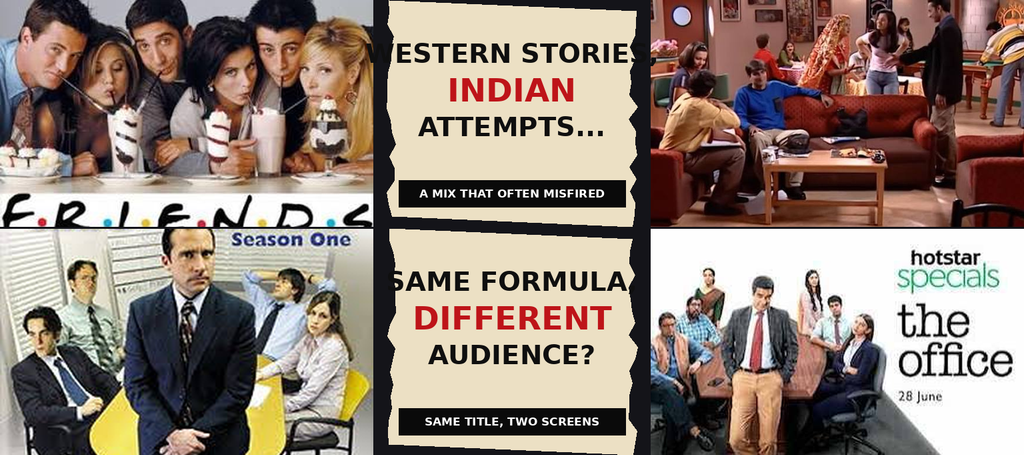
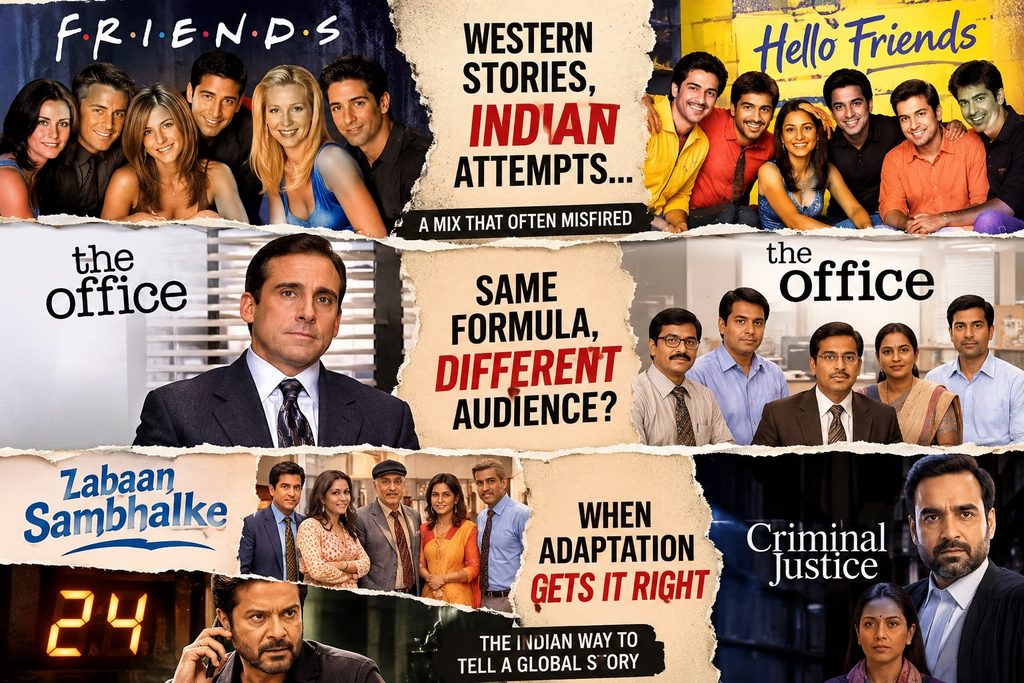
Take Friends, for instance. The American sitcom became a worldwide phenomenon because of its writing, character relationships, comic timing and the individuality of its six central characters. Its stories revolved around independent living, dating, professional uncertainty, romantic relationships and the everyday complications of adulthood.
India attempted to recreate that success with Hello Friends in 1999. Starring Cyrus Broacha, Simone Singh, Nikhil Chinapa and Maria Goretti, the Zee TV series borrowed heavily from the original. Even the characters, their professions, relationships and familiar settings were recreated with minimal imagination.
But the problem was not simply that the characters were Western. The problem was that the Indian version seemed more interested in reproducing Friends than developing a convincing Indian friendship story. Certain character backgrounds and relationships were altered, including the storyline involving Ross’s former wife, but these changes did not create a sufficiently distinctive identity for the show.
The series lasted only 26 episodes. It became a memorable example of how copying a successful international property does not automatically reproduce its success.
A similar situation emerged with the Indian adaptation of The Office in 2019. The original British sitcom, subsequently popularised through its American version, built its comedy around uncomfortable workplace interactions, awkward silences, office politics and the peculiar behaviour of its employees.
The Indian version shifted the setting to Wilkins Chawla, a paper company in Faridabad. On paper, it was an opportunity to explore the absurdities of Indian corporate life. Our workplaces have their own characters, hierarchies, office politics, regional humour and everyday frustrations. There was plenty of material to create something genuinely entertaining.
However, the adaptation remained excessively dependent on the American version. Several scenes, jokes and character interactions were reproduced almost frame by frame. Even expressions that worked naturally in English became awkward when translated into Hindi.
The problem was not that Indian audiences could not appreciate cringe comedy. It was that the writing did not consistently find an Indian comic rhythm. The result often felt like a translated performance rather than an independently imagined workplace comedy.
And this brings me to a larger problem with the way we approach Western storytelling.
A joke is not always universal. Dating culture, adult humour, romantic relationships, family expectations and social behaviour are influenced by the environment in which people grow up. A casual conversation between two American friends may carry a different social meaning when placed in an Indian household or workplace.
The same applies to LGBTQ+ representation. A character’s sexuality, relationships and personal conflicts cannot simply be removed or rewritten without considering how those changes affect the character’s identity and the larger narrative. An adaptation should understand Indian social realities, but it should not use cultural differences as an excuse to flatten complicated characters.
This is where I believe many remakes lose their direction. They either reproduce Western situations without understanding their context or modify them so extensively that the original character dynamics disappear. Neither approach necessarily produces good storytelling.
There is also an interesting contrast between remakes and dubbed international films.
When an Indian audience watches a Hollywood film dubbed in Hindi, it is still experiencing the original film’s world. The characters retain their motivations, relationships, behaviour and cultural identity. Even when certain dialogues are modified or scenes are censored, the larger narrative often remains intact.
Audiences can therefore experience unfamiliar social situations without requiring them to be converted into Indian equivalents. They can watch different approaches to dating, relationships, marriage, friendship and family life. In many cases, that difference is precisely what makes international cinema interesting.
Dubbing makes the story linguistically accessible; it does not necessarily make the story culturally Indian.
I find this distinction particularly important because Indian audiences have never been as culturally isolated as some adaptations seem to assume. Viewers can appreciate stories set in New York, London or Los Angeles without needing every character to behave like someone from Mumbai, Delhi or Kolkata.
However, this does not mean that international formats cannot succeed in India. In fact, some of our better adaptations prove exactly the opposite.
Take Zabaan Sambhalke, the Indian adaptation of the British sitcom Mind Your Language. Instead of simply recreating the original characters and their circumstances, it placed the language-learning premise within an Indian social environment, using students from different backgrounds and their interactions to generate comedy.
Similarly, Anil Kapoor’s 24 took the American thriller format and built an Indian narrative around it. The setting, characters and political circumstances gave the story a distinctly Indian identity while retaining the urgency and structure of the original concept.
Criminal Justice is another example of an international format being developed into a different Indian narrative environment. Its legal and social conflicts were presented through Indian institutions, characters and circumstances rather than simply transplanting the original story.
These examples reinforce my argument: an adaptation needs its own creative identity.

I do not believe every Western story needs to be Indianised. Nor do I believe that Indian audiences should only be offered stories that reflect their immediate surroundings. Cinema and television should introduce audiences to different cultures, perspectives and lifestyles. That is one of the most valuable aspects of international entertainment.
But when filmmakers decide to remake a story, they take on a different responsibility. They must understand the original’s emotional foundation and then find a way to make that foundation believable within the new setting.
For me, the biggest mistake is treating a successful international show or film as a ready-made blueprint. A familiar set, similar costumes, recreated characters and translated dialogues might attract initial curiosity, but they cannot replace original writing and character development.
India has its own extraordinary social realities, relationships, humour and everyday contradictions. There is no shortage of material for original storytelling. Our filmmakers do not need to imitate a New York coffee shop or a Pennsylvania paper company to create memorable characters.
A remake should borrow the soul of a story, not merely its scenes. And if filmmakers cannot understand what made the original special, perhaps they should stop trying to recreate it and start telling a story of their own.